Over the last decade we’ve become much more aware of the effects that concussions can have on a person, and how multiple concussions and repeated blows to the head can create long-term brain damage. We’ve all heard about how football leads to CTE and we’ve become very familiar with the many stories of NFL players suffering from the disease, but there’s one side of the story we haven’t heard yet.
In 2014 the NCAA released the results of a study based on self-reported concussion rates among student-athletes. The report showed the rates of self-reported concussions among men and women, as well as the odds of suffering a concussion in various sports, and one sport in particular stands out from the rest.
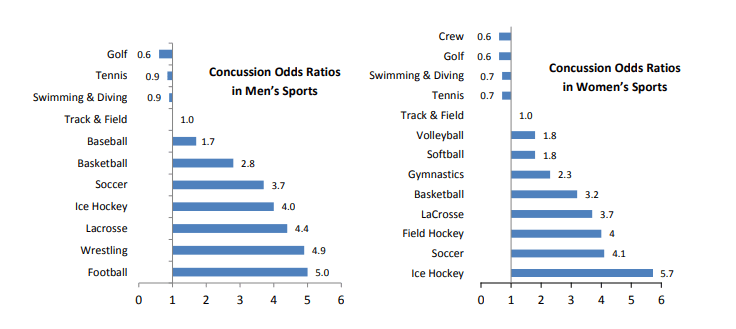
Women’s ice hockey has by far the highest rate of self-reported concussions in college athletics, despite having only 92 teams from all levels of NCAA competition. Even compared to the men’s game, women are 43% more likely to report having suffered from a concussion than men are.
Now obviously, being that these are self-reported there is a chance that players may not be truthful in their reporting. There has been a long tradition in men’s sports of “toughing it out” and not reporting injuries, including concussions, for fear of appearing weak. There’s also the chance that players may be exaggerating their claims of suffering from concussions. There was no medical study undertaken to examine the legitimacy of all reported concussions, so it’s possible that players are both under reporting and over reporting concussions.
Despite these flaws in the study, it’s still very obvious that women tend to suffer from concussions at a higher rate than men, and that’s with women reporting concussions at a lower rate than men.

Even when comparing sports played by both genders like soccer, basketball, and ice hockey, the women have the higher odds of receiving a concussion.
Our next question has to be, why is this the case? The obvious first answer would be that women aren’t able to handle the physical contact of hockey like men are, but the study concludes that the risk factor for concussions was not significantly affected by the participant’s sex. In fact the study concludes that the sport a student-athlete was playing was the most important risk factor for players. It’s also important to point out that women’s ice hockey does not allow checking like the men’s game, so hard contact is not as likely although it does still happen.
Another significant factor in the rate of concussions would be the sample size of the athletes surveyed. There are only 92 women’s ice hockey teams at all levels of the NCAA compared to 149 men’s ice hockey teams. A smaller sample size would mean that one female athlete reporting a concussion would have a larger impact on the percentage than one male athlete would. This would help to explain the differences in the rates in sports like basketball, and soccer, but the rate of concussions in the women’s game is so much higher than the men’s game that it can’t just be explained away as a problem with sample size.
The study itself doesn’t offer any answers to the question either, and instead leaves the results open to interpretation. What we can say for sure is that there is a problem with women’s ice hockey and that something needs to be done to help lower the concussion rates in the sport. The problem is that, much like other women’s sports, there isn’t a large following, and most fans of the sport likely don’t even know about the high rate of concussions. Right now women’s ice hockey is in a similar position as the NFL and NCAA were in the 80s and 90s where concussion rates are high, but awareness of the problem is very low.
This is an issue that needs to be addressed, but it won’t be addressed if people don’t know about it. Now that you know it’s time to get the word out and let the NCAA know that we want player safety to be the focus of all sports, not just football.

 Fernando and Dylan's Blog